


Oil Return Problems and Solutions in Refrigeration Compressors
One of the most common and hidden causes of compressor failures in industrial refrigeration systems is oil return problems. We examine how you can prevent mechanical damage caused by oil failing to return to the compressor through engineering solutions such as proper piping, oil traps (p-traps), and oil separator usage.
This article was automatically translated from the Turkish original.
Oil Return Problems and Definitive Solutions in Refrigeration Compressors
In industrial refrigeration and chiller systems, compressors are the heart of the system. Another component just as important as the refrigerant (gas) for the healthy operation of the compressor is the lubricating oil. Oil reduces friction in moving mechanical parts, provides sealing, and prevents the compressor from overheating.
However, in refrigeration systems, oil does not stay solely in the crankcase. Along with the refrigerant, it mixes into the system through the discharge line and circulates through the entire piping network. This oil entering the system must return to the compressor at the same rate. Situations where it fails to return are known as "oil return problems," and this can lead to fatal consequences for the compressor mechanics.
What Causes Oil Return Problems?
Design or operational errors usually lie behind the inability of the oil in the system to return to the compressor crankcase (oil sight glass). The most common causes are as follows:
1. Low Refrigerant Velocity
For oil to move through the piping and return to the compressor, the gas must "drag" it along. If the compressor operates under part-load (low capacity) for extended periods or if the pipe diameters are oversized, the gas velocity drops. Gas with reduced velocity cannot carry oil upward, especially in vertical copper pipe lines, causing oil to accumulate in the evaporator or at the bottom of the piping.
2. Improper Piping and Lack of Oil Traps (P-Traps)
Piping design is critical in refrigeration engineering. If the evaporator is located at an elevation lower than the compressor, oil traps (P-traps or U-bends) must be installed on the vertical sections of the suction line so that the gas can carry the oil upward. Failing to install a trap every 3 to 4 meters of vertical rise causes the oil to remain at the bottom due to gravity.
3. Oil Separator Failures
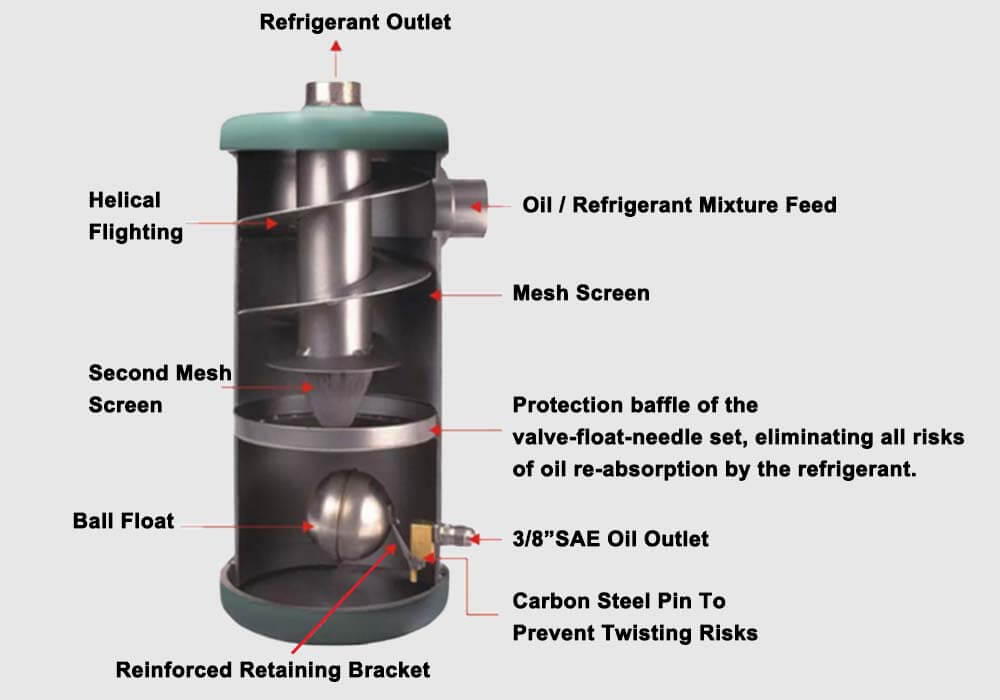
Oil separators installed immediately at the compressor discharge catch 95-98% of the oil mixed with the gas and return it instantly to the compressor. Malfunctioning float mechanisms or clogged filters inside the oil separator cause oil to escape into the entire system and fail to return.
4. Oil Accumulation in the Evaporator
At very low temperatures (-20°C and below), the viscosity (resistance to flow) of the oil increases—meaning the oil thickens. Thickened oil sticks to the evaporator surfaces. This both prevents oil return and creates an insulating effect on the evaporator, severely reducing cooling capacity (heat transfer).
How Do You Identify an Oil Return Problem?
Low Level in the Sight Glass: If the oil level in the sight glass on the compressor is consistently below one-quarter or not visible at all.
Noisy and Vibrational Operation: Friction noise increases from metal parts lacking lubrication.
Drop in Cooling Performance: Oil accumulated in the evaporator hinders heat transfer, preventing the system from reaching the desired operating temperature.
Compressor Overheating: Since oil also acts as a coolant, lack of oil causes abnormal heating of the compressor body.
FSI Refrigeration's Solution Approach
Solving oil return problems does not simply mean "adding missing oil" to the system. Continuously topping up oil without identifying the root cause can lead to liquid slugging (liquid shock) and piston/scroll breakage when the oil suddenly returns to the compressor later on.
At FSI Refrigeration, we follow these steps in the field:
Thermodynamic check of pipe diameter and gas velocity calculations.
Installing double risers or oil traps (p-traps) on required vertical lines.
Mechanical and efficiency testing of oil separators.
Optimizing crankcase heaters and superheat settings via TXV if necessary.
An expert engineering touch is essential to protect the compressors—the heart of your system—and to prevent costly breakdowns. If you are experiencing oil level issues or capacity drops in your industrial refrigeration system, contact us for our periodic maintenance and overhaul services.
Engineering support for your system
Contact our team for chiller selection, a maintenance plan or breakdown response.